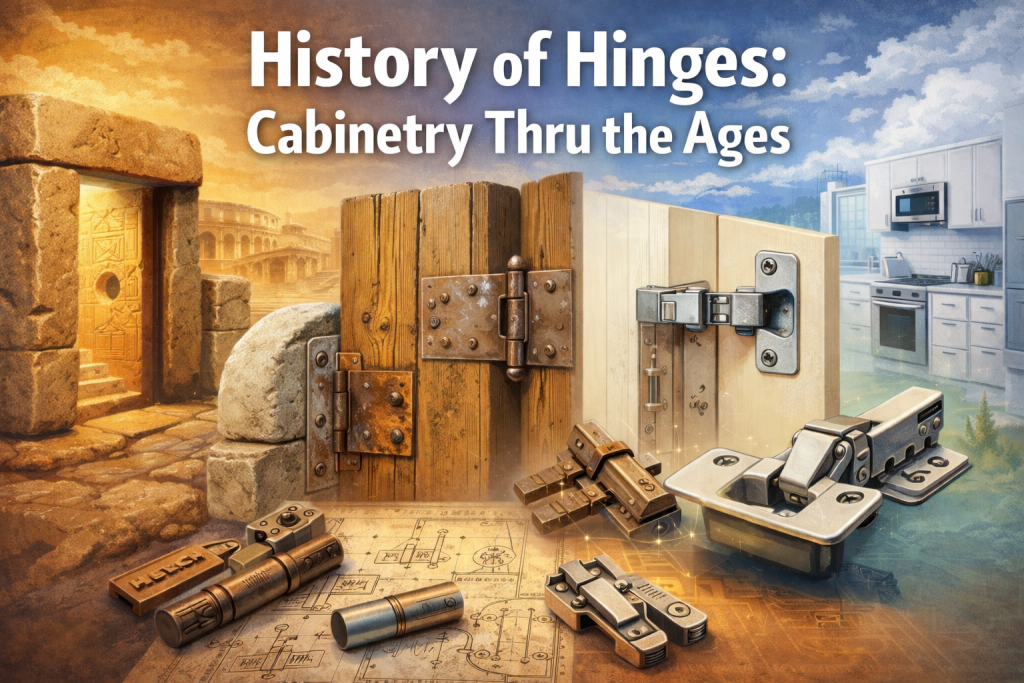

Hinges are among the oldest hardware in human civilization. Most people never think about them. They open a cabinet door, close it, and move on. But that effortless motion is the product of 3,500 years of engineering, war, economics, and industrial invention.
Today, the global door hinges market exceeds $9.5 billion. The concealed hinge alone is a $1.3 billion category projected to reach $2.07 billion by 2034. (Global Market Insights, 2024; Global Market Insights, 2025) The hardware holding your cabinet doors to your cabinet boxes has a longer, stranger, and more consequential history than almost anyone realizes.
This is that history.
Quick Skim: History of Cabinet Hinges
| Era | Milestone |
|---|---|
| ~1520 BCE | Earliest written reference to door fastening mechanisms (Book of Job) |
| Pre-industrial | Iron butt hinge dominates worldwide; still the #1 hinge type by revenue today |
| 1888 | Hettich founded in Germany as a clock parts manufacturer |
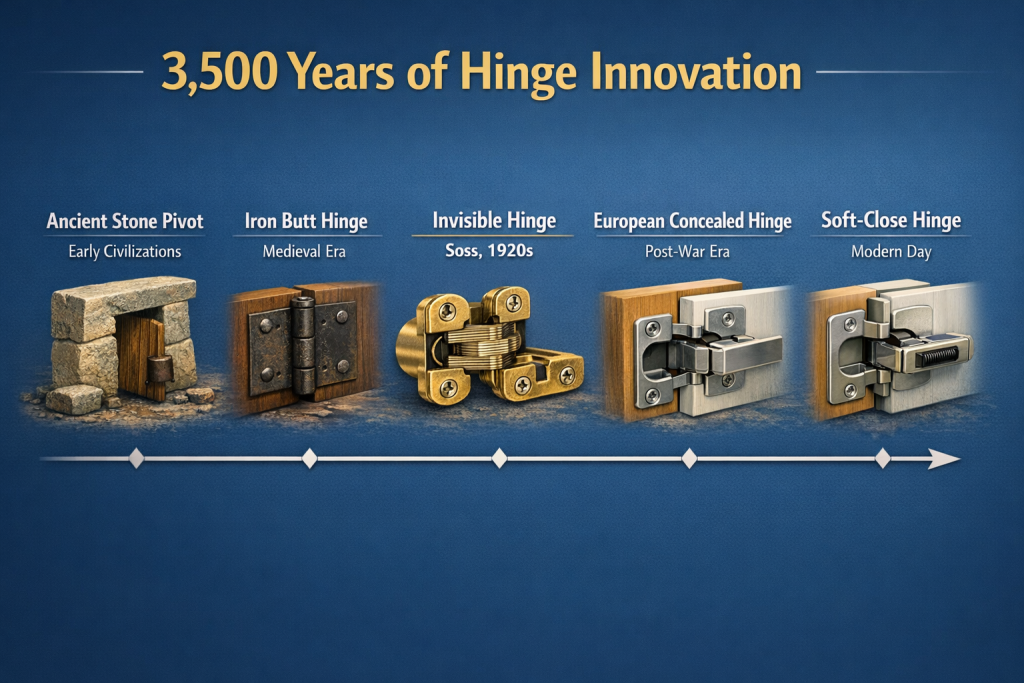
| 1924 | Joseph Soss patents the invisible hinge; five-axis design unchanged 100 years later |
| Post-WWII | European 32mm frameless cabinet system born from post-war wood shortages |
| 1952 | Julius Blum founds his company in Austria; first product is a horseshoe stud |
| 1964 | Blum launches its first dedicated furniture hinge |
| 1977 | Blum introduces the MODUL hinge |
| Early 2000s | Blum launches the first concealed hinge with integrated soft-close |
| 2013 | Blum BLUMOTION wins the European Inventor Award |
| 2024 | Global door hinges market exceeds $9.5B; concealed hinges reach $1.3B |
| 2025 | India mandates BIS quality certification for all domestic cabinet hinges |
Ancient Origins: Doors Before Hinges
The earliest documented reference to door fastening mechanisms appears in the Book of Job, written around 1520 BCE, which describes the sea as being “shut up with doors.” A 19th-century academic lecture published by the Historic Society of Lancashire and Cheshire traces hinges, pivots, and latches as the foundational hardware elements of ancient civilization alongside bars, bolts, locks, and keys. (HSLC, 2017 reprint)
Ancient Egyptian, Greek, and Roman architecture used stone pivots and bronze pin hinges on doors. These were functional but crude. The door hung on a vertical pin set into the threshold and lintel. It rotated. It did not swing clean. There was no adjustment. Wear meant replacement.
For centuries, that was the standard. Iron butt hinges emerged in medieval Europe and became the dominant form of door hardware for hundreds of years. Even today, butt hinges generate more revenue than any other hinge category in the world: $3.6 billion in 2024 alone, representing the single largest segment of the global door hinges market. (Global Market Insights, 2024)
The butt hinge is not a relic. It is the most widely installed hinge in the world. Understanding why requires understanding what came next and why the industry chose a different path for cabinetry specifically.
1888: A Clock Parts Manufacturer Enters the Picture
The story of modern cabinet hinges does not begin with a cabinet maker. It begins with clocks.
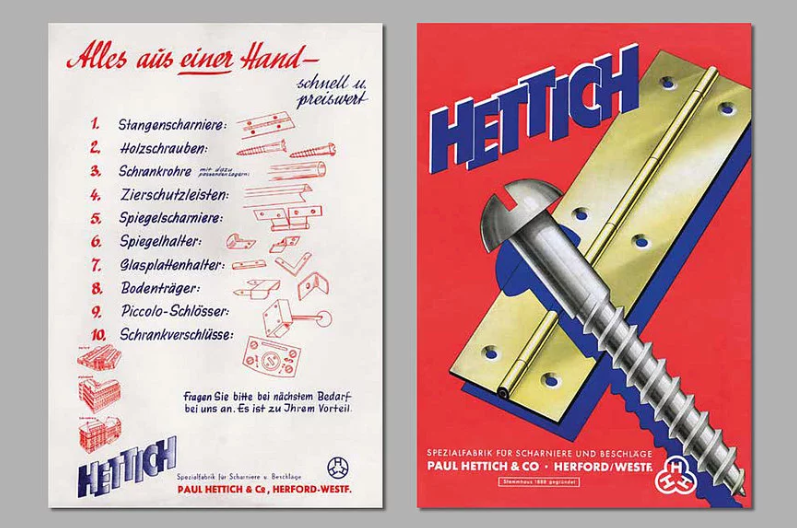
In 1888, Karl Hettich founded a small manufacturing operation in the Black Forest region of Germany. His first product was a manual bending machine for producing pendulum clock anchor escapements. Clock parts. That company, now known as Paul Hettich GmbH and Co KG, is today one of the world’s largest furniture fittings manufacturers. (Hettich, 2024)
The leap from clock components to cabinet hardware seems improbable. It was not. Precision manufacturing, close tolerances, and high-volume production are the same skills whether you are making escapements or hinges. Hettich applied that precision to furniture hardware and built an empire on it.
Later, August Hettich developed a fully automated 16-meter production line for piano hinges, which became the foundation of the company’s Technology for Furniture business unit. (Hettich, 2024) The piano hinge, a continuous hinge running the full length of a door, was the dominant cabinet hardware solution for much of the 20th century. Hettich owned that market.
Then the piano hinge lost prominence.
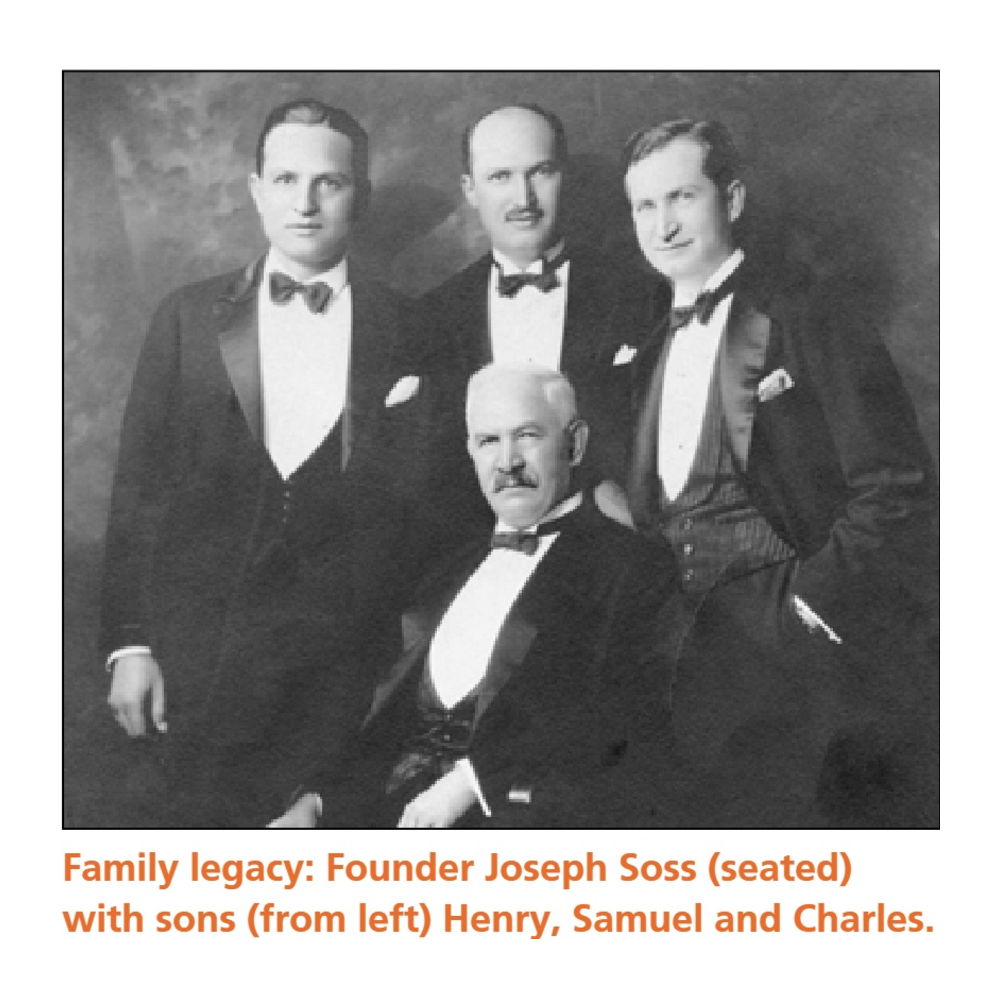
1924: Joseph Soss and the Invisible Hinge
Before the European concealed hinge reshaped cabinetry, an American inventor took the first shot at making hinges disappear entirely.
Joseph Soss invented the invisible hinge in 1924. A 2017 peer-reviewed paper published in the Journal of Applied Mechanics and Engineering analyzed the kinematics of the original Soss hinge design and confirmed that the patent drawings showed a hinge with three fixed axes and two slideable rotational axes. (Toropov and Robertis, Journal of Applied Mechanics and Engineering, 2017)
That five-axis structure remains the dominant architecture for invisible hinges used in applications today, from interior doors to notebook computers to boat cockpit hatches. A design first patented 100 years ago still shapes the invisible hinges installed on high-end cabinetry today.
Most commercially available invisible hinges use a symmetrical design, meaning the door bracket and the frame bracket are equal in length. That detail from the original 1924 patent drawings has not changed in a century. (Toropov and Robertis, 2017)
The Soss hinge was remarkable. It was also niche. It required precise routing, it was expensive, and it did not lend itself to mass production. The next revolution in concealed hinges would not come from an American inventor. It would come from the rubble of World War II.
How World War II Changed Cabinet Hardware Forever
Post-war Europe faced a simple, devastating problem: not enough wood.
The rebuilding of Europe after 1945 created explosive demand for cabinetry, furniture, and housing. The traditional framed cabinet construction method consumed large quantities of solid wood, which was scarce. Manufacturers needed a new system. They built one.
Frameless cabinetry, also known as the European 32mm system, was developed in direct response to that post-war wood shortage combined with the massive rebuilding demand. (Euro 32 Products, 2020) Instead of a face frame consuming material at the front of the cabinet box, frameless construction used the full interior width of the box. Less wood. More usable space. Faster to build.
The system required a new kind of hinge. One that attached to the inside of a door and the inside of a cabinet box. One that could be adjusted after installation. One that was invisible from the outside. The European concealed hinge was born.
Why 32mm? The Answer Is Engineering Accidents
The 32mm spacing standard was not chosen by designers. It was imposed by machines.
According to a published technical manual from Veritas, the 32mm dimension was set by the minimum practical diameter of the gears driving the spindles of line-boring machines. Any smaller, and the gears would have produced unacceptable spindle-bearing wear. (Veritas / Axminster Tools, Cabinetmaking System Manual)
A manufacturing constraint became the global standard. Every concealed cabinet hinge made today, by Blum, Salice, Grass, Hettich, or anyone else, is designed around a spacing standard that exists because gear metallurgy in 1950s Germany had physical limits.
That is how standards are made.
1952: A Farrier’s Apprentice Builds the Most Famous Hinge Company in the World
Julius Blum was a farrier and carriage smith. He founded his hardware company on March 1, 1952, in Hoechst, Austria. His first product was a horseshoe stud, a device designed to keep horses from slipping on ice. (Julius Blum GmbH, Company History, 2024)
The company that today puts hinges in more kitchen cabinets than any other manufacturer started by keeping horses on their feet.
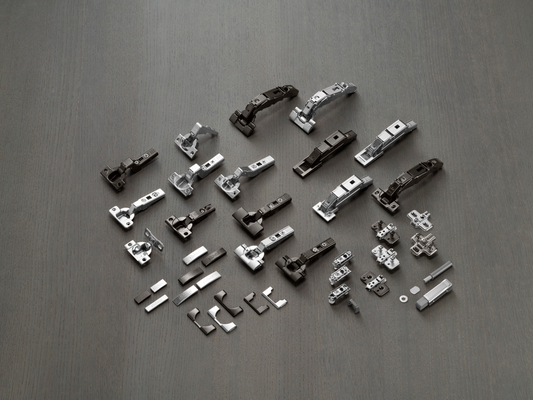
Blum produced the ANUBA hinge for doors, windows, and furniture shortly after founding, then moved into concealed furniture hinges as a separate product line. By 1964, Blum launched its first dedicated furniture hinge into the market. By 1977, the company had presented the MODUL hinge, a landmark product in cabinet hardware. (Blum, Hinge Systems Overview, 2024)
The CLIP mechanism changed installation. Blum’s CLIP, CLIP top, and CLIP top BLUMOTION hinges introduced tool-free door-to-cabinet assembly through a proprietary snap-on system. No screwdriver required to mount a door. The INSERTA assembly method further standardized professional cabinet assembly lines, reducing labor time significantly. (Blum, 2024)
Then came soft-close.
Blum introduced its first concealed hinge with integrated soft-close in the early 2000s. The BLUMOTION system won the European Inventor Award in 2013, the highest level of European intellectual property recognition. (Blum, 2024) The award validated what cabinet makers already knew: BLUMOTION was not an incremental improvement. It was a category redefining product.

The Four-Pivot Hinge and the Death of the Piano Hinge
Back at Hettich, the pivot point came when the company was granted a patent license for manufacturing concealed hinges. The new four-pivot concealed hinge superseded the piano hinge almost completely in the furniture industry. (Hettich Microsite, 2024)
That is not a gradual shift. That is a category displacement. An entire product type, the continuous piano hinge that Hettich had helped perfect, was made largely obsolete by a new design that offered adjustability, concealment, and soft-close capability.
Hettich’s System 32 subsequently shaped the design and production of ready-to-assemble furniture worldwide. RTA furniture, including virtually every flat-pack cabinet system sold today, runs on the European 32mm standard that Hettich helped commercialize.
Hettich’s modern Intermat and Sensys hinges feature ergonomic snap-on assembly with five-point clamping that clicks audibly into place. The Sensys hinge includes an automatically closing angle of 35 degrees, meaning the door pulls itself closed from that point without any additional force. The temperature-stable damper is rated for operation from 5 to 40 degrees Celsius. The Euromat TOPsafe clip technology is documented to be up to 50% faster to install than traditional screw-on hinge systems. (Hettich, Onsys Technical PDF, 2024)
The Standard That Ties It All Together: 35mm
Every major European concealed hinge brand uses a 35mm cup bore diameter drilled into the back of the cabinet door. The standard placement is 3.5 inches from the top or bottom of the door to the center of the bore hole. For half-inch overlay applications, the bore sits 3 inches from the door edge. That dimension is consistent across Blum, Salice, Grass, and Hettich. (Hampton Bay / THD Cabinet Measure Guide)
This cross-brand compatibility is not an accident. It is the product of decades of European industry standardization built around the 32mm system.
One important nuance: Grass produces hinges that use both HBP200 and HBP300 drilling patterns, creating compatibility considerations for professionals selecting hinges for frameless versus face-frame applications. Blum and Salice both use the same drilling pattern, simplifying specification for most installations. (WalzCraft, Hinge Boring Technical PDF)
That detail matters. Knowing it before you buy saves you a return trip to the supplier.
The Market Today: Who Is Buying, and Why
The U.S. door hinges market reached $1.8 billion in 2024, growing at 5% annually. (Global Market Insights, 2024) Stainless steel holds 40 to 47% of global market share for hinge materials, driven by corrosion resistance and the premium aesthetics of modern residential and commercial cabinetry. (Market.us, 2025)
The people driving that spending are increasingly professionals, not DIYers. According to Harvard’s Joint Center for Housing Studies, professionally installed home improvements grew 28% between 2021 and 2023 to $340 billion, representing 84.1% of all owner-occupied home improvement spending. DIY project outlays declined 13% in real terms over the same period. (Harvard JCHS, 2025)
Professional installers specify professional hardware. That is what drives demand for Blum, Hettich, Salice, and Grass at the trade level.
Design trends are accelerating the shift toward concealed hinges. The NKBA’s 2026 Kitchen Trends Report found that 69% of designers named flat slab cabinet door styles as trending, and 85% identified panel-faced dishwashers as gaining popularity. Both require concealed hinges. Exposed butt hinges do not work on a slab door. (NKBA, 2025) Meanwhile, 60% of NKBA respondents identified minimalism as a dominant design style, which directly correlates with demand for hardware that disappears. (NKBA, 2025)
Despite the dominance of major brands, the market remains highly fragmented. The top five global players, Hettich, Blum, Grass, Hafele, and FGV, hold only about 20% of total market share combined. (Intel Market Research, 2025) China holds approximately 35% of world market share, while North America and Europe together account for roughly 45%. (Intel Market Research, 2025)
Even in 2025, no single company dominates the hinge market. The category remains wide open.
From Job to BLUMOTION: A 3,500-Year Arc
Start in the Bronze Age with a stone pivot and a wooden door. End with a self-closing, tool-free clip hinge that a cabinet shop can install 50% faster than anything that came before it.
The line connecting those two points runs through ancient Rome, medieval iron work, a 19th-century clock parts workshop in Germany’s Black Forest, a farrier’s stall in Hoechst, Austria, and the rubble of post-WWII Europe. It is a line shaped by material shortages, manufacturing constraints, patent licenses, and an American inventor who decided in 1924 that hinges should be invisible.
The best hinges on the market today are the direct descendants of all of that history. When you specify a Blum BLUMOTION or a Hettich Sensys, you are installing something that took three and a half millennia to develop.
Shop Cabinet Hinges at WoodworkerExpress
Woodworker Express carries the full range of Blum, Salice, Grass, and Hettich concealed cabinet hinges, including soft-close, full overlay, half overlay, and inset configurations.
Whether you are a homeowner replacing worn hinges or a cabinet shop specifying hardware for a full kitchen build, we have what you need in stock and ready to ship.
Sources
- Historic Society of Lancashire and Cheshire, “Sketch of the History of the Ancient Modes of Fastening Doors” (19th century academic lecture, 2017 reprint): https://www.hslc.org.uk/wp-content/uploads/2017/11/2-15-Higgin.pdf
- Toropov and Robertis, “Kinematics of Invisible Hinge,” Journal of Applied Mechanics and Engineering (2017): https://www.walshmedicalmedia.com/open-access/kinematics-of-invisible-hinge-2168-9873-1000281.pdf
- Euro 32 Products, “Euro 32 Hole-Boring System Manual” (2020): https://euro32products.com/wp-content/uploads/2020/04/CondensedEuro32Manual.pdf
- Veritas / Axminster Tools, “Veritas 32 Cabinetmaking System Manual”: https://www.axminstertools.com/media/downloads/474142_manual.pdf
- Julius Blum GmbH, Official Company History (2024): https://www.blum.com/au/en/company/company-history/
- Julius Blum GmbH, Hinge Systems Overview (2024): https://www.blum.com/us/en/products/hingesystems/overview/
- Julius Blum GmbH, How to Identify Hinge Systems (2024): https://www.blum.com/aa/en/company/quality-innovation/identify-blum-products/hingesystems/
- Paul Hettich GmbH and Co KG, Official Company History (2024): https://corporate.hettich.com/en-de/companys-history
- Paul Hettich GmbH, Company History Microsite (2024): https://microsite.hettich.com/en-de/company/the-companys-history
- Hettich AG, Onsys Hinge Technical PDF (2024): https://web.hettich.com/fileadmin/Company_website/HIN/Media/HIN_Onsys.pdf
- Global Market Insights, Door Hinges Market Size and Share Industry Analysis 2025-2034 (2024): https://www.gminsights.com/industry-analysis/door-hinges-market
- Global Market Insights, Door Invisible Hinges Market Size, Share and Forecast 2025-2034 (2025): https://www.gminsights.com/industry-analysis/door-invisible-hinges-market
- Market.us, Door Hinges Market Size, Share and Growth Trends Report 2025-2034 (2025): https://market.us/report/door-hinges-market/
- Intel Market Research, Door Hinge Market Outlook 2025-2032 (2025): https://www.intelmarketresearch.com/door-hinge-market-16547
- NKBA, Cabinetry Study Reveals a $30 Billion Market (2018): https://kb.nkba.org/uploads/2016/11/2018-Cabinetry-Study-Reveals-a-30-Billion-Market_2.22.18.pdf
- NKBA / KBIS, 2026 Kitchen Trends Report Press Release (2025): https://kb-media.nkba.org/wp-content/uploads/2025/09/Final_2026-Kitchen-Trends-Report-Press-Release.pdf
- Harvard Joint Center for Housing Studies, Improving America’s Housing 2025 Key Facts (2025): https://www.jchs.harvard.edu/sites/default/files/interactive-item/files/Harvard_JCHS_Improving_Americas_Housing_2025_Key_Facts.pdf
- Hampton Bay / THD, Cabinet Measure Guide: https://images.thdstatic.com/catalog/pdfImages/28/280fb45d-938d-4ba5-beb4-2318d73849cb.pdf
- WalzCraft, Hinge Boring for Cabinet Doors Technical PDF: https://walzcraft.com/wp-content/uploads/2013/04/F1-Hinge-Boring-for-Cabinet-Doors.pdf